Posts

Showing posts with the label Plant species

Learn what biodiversity is, and why you should care about biodiversity loss!

Image
"Everything on our planet - including us - is interconnected and interdependent, like a delicate set of bricks or Jenga tower. The more bricks and the more connections between them, the stronger the tower. But when one piece falls, the whole structure can come crashing down. "

It is the animals, plants, fungi, and micro-organisms that make up our natural world and ecosystem.

Image
  What is Biodiversity ?

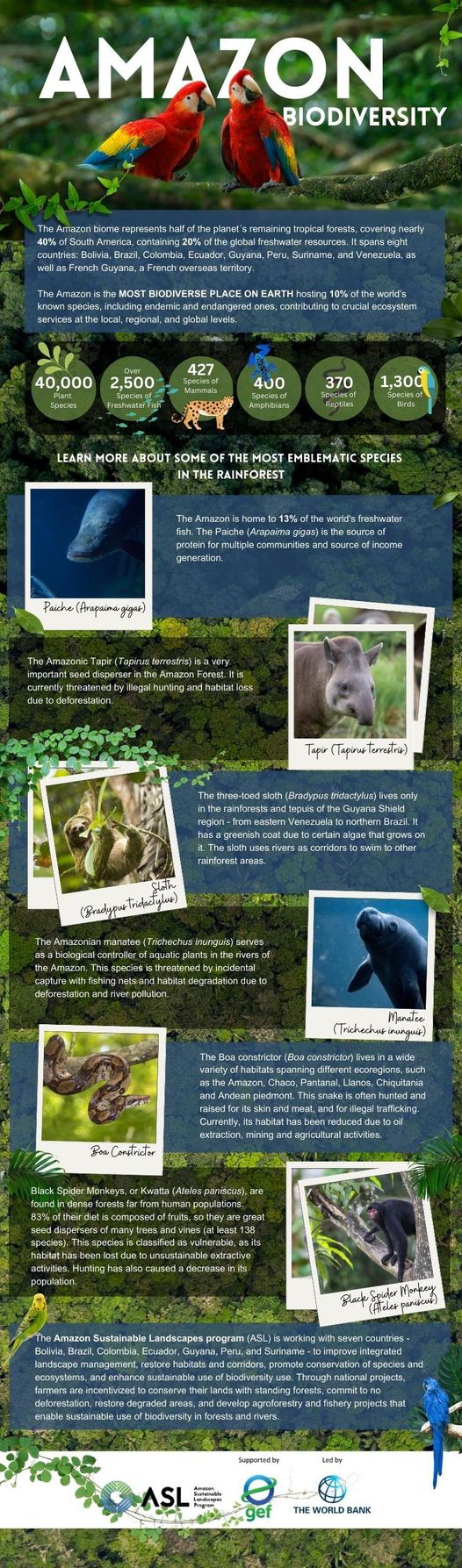
Amazon biological diversity never ceases to amaze!

Image
 

Have you heard of One Health?

Image
It’s a relationship between humans, animals, plants and the environment . It relies on the understanding of how human actions and policies could affect animal, plant & environment health and how it impacts humans as a result . A One Health Approach helps tackle health threats by linking humans, animals, plans and environment together.

Why Biodiversity matters?

Image
 

Threats to biodiversity.

Image
 

Is there a biodiversity Crisis?

Image
Yes. It’s very serious, and it needs to be urgently tackled. Starting with the natural and land sea carbon sinks mentioned above. They are being degraded, with examples including the deforestation of the Amazon and the disappearance of salt marshes and mangrove swamps , which remove large amounts of carbon. The way we use the land and sea is one of the biggest drivers of biodiversity loss . Since 1990, around 420 million hectares of forest have been lost through conversion to other land uses. Agricultural expansion continues to be the main driver of deforestation, forest degradation and forest biodiversity loss . Other major drivers of species decline include overfishing and the introduction of invasive alien species (species that have entered and established themselves in the environment outside their natural habitat, causing the decline or even extinction of native species and negatively affecting ecosystems). These activities, UNEP has shown , are pushing around a million spec...

Urgent action is needed to halt and reverse biodiversity loss.

Image
Healthy ecosystems are a source of food, water, medicine, shelter and more. Yet, human activities have altered most terrestrial habitats. Urgent action is needed to halt and reverse biodiversity loss. Follow the conversations with the hashtags: #BuildBackBiodiversity , #BiodiversityDay on May 22nd.

THE WHITE FERULA MUSHROOM FALLS INTO EXTINCTION.

Image
The White Ferula Mushroom is Critically Endangered . It is estimated that only 250 white Ferulas make it to maturity each year . Species Categorized as Critically Endangered (CE) . An IUCN Red List Critically Endangered (CR) or sometimes (CE) species is one that has been categorized by the International Union for Conservation of Nature as facing an extremely high risk of extinction in the wild. The Red List Index (RLI) can also be disaggregated to produce national and regional Red List Indices by weighting by the fraction of each species' distribution occurring within a particular country or region, building on the methodology published by  Rodrigues  et al .  (2014) . These show how well species (in the groups covered) are conserved in the country or region relative to its potential contribution to global conservation of these species groups . An alternative approach is to produce national RLIs based on repeated assessments of extinction risk at the na...

THE EBONY TREE FALLS TO EXTINCTION.

Image
  The D. crassiflora is a medium-sized, slow-growing tree up to 25 meters tall. It is found in lowland semi-deciduous and evergreen forest , up to about 1000 m in elevation, and tends to avoid the wettest forests. It is not a common tree in natural forests , usually found alone or in a small group of 2 or 3 trees. It is harvested by selective logging throughout its natural range, and the wood is considered the true commercial ebony from Africa. The heartwood, the most famous part of the tree’s timber, is jet-black or very dark brown with black streaks. It is very dense and used for heavy flooring, ship building, vehicle bodies, knife handles, guitar fingerboards and, most famously, the black keys of pianos. The bark and sap of the tree have been shown to have antibacterial and antifungal properties, and they are used in traditional local medicine to help treat a variety of ailments.The  D. crassiflora timber has been an important export product from its range countries for y...